
Institutional Notice (Zero-Custody): This content is strictly technical, regulatory, and informational in nature, and does not constitute an offer of securities, financial advisory, investment return guarantee, or private legal counsel. The platform operates as engineering evidentiary proof software (proof ledger) with a zero-custody architecture, does not manage third-party financial resources, and does not replace non-delegable statutory decisions of the National Electric Energy Agency (ANEEL), National Water and Basic Sanitation Agency (ANA), National Electric System Operator (ONS), or licensing environmental authorities.
The hydropower CAPEX challenge: capital intensity and site asymmetries
The deployment of Small Hydropower Plants (SHPs — facilities with installed capacity between 5 MW and 30 MW and reservoir areas up to 13 km², per sector statutory definitions) represents one of the most durable and noble assets of the renewable matrix. Providing dispatchable baseload generation with minimal environmental footprint compared to large dams, SHPs deliver essential local voltage regulation and stability to the National Interconnected System (SIN).
However, from an engineering and project finance standpoint, SHP projects present a distinctly asymmetric risk profile compared to solar photovoltaic or wind assets:
1. Capital intensity and long construction cycles: Capital expenditure (CAPEX) historically ranges between R$ 8,000 and R$ 13,000 per installed kW, with construction schedules spanning 18 to 36 months;
2. Geological and foundation geotechnical risk: Rock mass blasting, slope stabilization, and rock permeability for dam seating preclude modular prefabrication;
3. Hydrological dependency and seasonality: River diversion and spillway concreting require precision scheduling during dry-season windows, as unseasonal floods can breach cofferdams and cause catastrophic delays;
4. Temporal mismatch between cash disbursements and electromechanical delivery: Heavy hydro turbines and synchronous generators require manufacturing down payments with factory lead times exceeding 12 months.
Without strict fiduciary governance anchored in segregated escrow accounts and independent Owner's Engineering inspection reports, unhedged cash advances shift the entire contractor default or delay risk onto project creditors and Special Purpose Entity (SPE) equity holders.
The preliminary regulatory tripod: ANA, environmental authorities, and ANEEL
No substantial construction capital disbursement may take place prior to the full satisfaction of statutory administrative conditions precedent. SHP project viability depends upon three core regulatory authorities:
1. Water Resources Concession and Grants (ANA and State Agencies)
Governed by Federal Law No. 9,433/1997 (National Water Resources Policy), the water grant authorizes water diversion and head utilization for hydroelectric generation. For federal river basins (interstate or transboundary rivers), exclusive authority resides with the National Water and Basic Sanitation Agency (ANA); state rivers fall under provincial water departments.
The water grant enforces non-negotiable operational parameters:
- Minimum ecological instream flow: Minimum water volume that must continuously bypass the intake through the natural riverbed to sustain downstream aquatic ecosystems;
- Flow-duration curve and reference flow ($Q_{95}$): Historical hydrological time series confirming water availability 95% of the time, anchoring design capacity and physical energy guarantee;
- Reservoir water level benchmarks: Maximum normal reservoir elevation (NA Max), upstream and downstream, preventing unauthorized backwater encroachment on adjacent properties.
2. Three-Phase Environmental Licensing (CONAMA Resolution 237/1997)
Environmental compliance strictly follows a three-stage statutory regime:
- Preliminary License (LP): Validates location and environmental feasibility based on Environmental Control Reports (RCA) or Environmental Impact Assessments (EIA/RIMA);
- Installation License (LI): Authorizes physical civil works, dam excavation, river diversion, and access roads, contingent upon execution of Basic Environmental Plans (PBA);
- Operating License (LO): Issued exclusively upon completion of construction, reservoir clearing, and impoundment inspection, authorizing commercial energy generation.
3. ANEEL Authorization Grant (Normative Resolution 875/2020)
ANEEL Normative Resolution No. 875/2020 streamlined authorization procedures for SHPs and Hydroelectric Generating Units (CGHs). ANEEL reviews the Basic Project Design (PB), defines authorized capacity, grants commercial exploitation rights for up to 35 years, and approves the mandatory milestone construction schedule. Unjustified milestone slippage triggers contractual penalties, performance bond execution, and concession forfeiture.
Physical and financial segregation: Civil Works vs Electromechanical Assembly
The cornerstone of SHP CAPEX ring-fencing is the rigorous budgetary, contractual, and operational separation between two distinct industrial scopes, which must never be contracted under an unmonitored monolithic turnkey lump-sum:
                      ┌────────────────────────────────────────────────────────┐
                      │                 TOTAL SHP CAPEX BUDGET                 │
                      └──────────────────────────┬─────────────────────────────┘
                                                 │
                  ┌──────────────────────────────┴─────────────────────────────┐
                  ▼                                                            ▼
   ┌──────────────────────────────┐                             ┌──────────────────────────────┐
   │     HEAVY CIVIL WORKS        │                             │ ELECTROMECHANICAL SUPPLY     │
   │    (~55% to 65% of CAPEX)    │                             │    (~30% to 35% of CAPEX)    │
   ├──────────────────────────────┤                             ├──────────────────────────────┤
   │ • River diversion/cofferdams │                             │ • Turbines (Kaplan/Francis)  │
   │ • RCC / Gravity dam          │                             │ • Synchronous Generators     │
   │ • Spillway & water intake    │                             │ • Gates & Hydromechanicals   │
   │ • Headrace canal / tunnel    │                             │ • SCADA & Plant Automation   │
   │ • Powerhouse & tailrace      │                             │ • Step-Up Substation (SE)    │
   └──────────────────────────────┘                             └──────────────────────────────┘
Civil Works Scope (~55% to 65% of CAPEX):
Contracted under unit-price or lump-sum agreements with monthly on-site physical measurement certifications. Disbursements are tied to certified in-situ material volumes:
- Open-pit and underground rock excavation ($m^3$);
- Roller-Compacted Concrete (RCC) in dam monoliths and Conventional Structural Concrete (CVC) in spillway blocks and piers ($m^3$);
- High-yield steel rebar (tons) and foundation consolidation and curtain grout injections (drilled linear meters and cement bags).
Electromechanical Supply Scope (~30% to 35% of CAPEX):
Contracted under industrial Supply & Erection agreements. Disbursements correspond to verifiable milestone stages:
- Final approval of electromechanical detailed design and scaled physical hydraulic model tests;
- Sourcing of certified raw materials (stainless steel plates for runners and stators, forged rotor shafts);
- Factory Acceptance Testing (FAT) with non-destructive examination (ultrasound, dye penetrant, insulation withstand, overspeed tests);
- Site delivery (DDP) and certified offloading at powerhouse staging pads;
- On-site erection, runner lowering, turbine-generator shaft alignment, and Site Acceptance Testing (SAT).
Auditable milestone matrix for fiduciary CAPEX disbursement
To eliminate fund commingling and premature liquidity release, segregated escrow disbursements follow a rigorous physical milestone matrix verified by an independent Owner's Engineer with formal technical responsibility:
Hydrological risk mitigation: GSF, seasonality, and physical guarantee
Beyond civil construction risks, debt service sustainability in an SHP hinges on its statutory Physical Energy Guarantee (GF), the maximum commercializable energy cap established by the Ministry of Mines and Energy (MME) and ANEEL.
In the wholesale electricity market, systemic hydrological risk is reflected through the Generation Scaling Factor (GSF) within the Energy Reallocation Mechanism (MRE):
$$E_{billable} = GF \times GSF \times P_{PLD}$$
Where:
- $GF$ represents the plant's certified physical energy guarantee in average MW;
- $GSF$ is the nationwide hydroelectric shortfall index calculated monthly by CCEE, often below 1.0 during severe dry spells;
- $P_{PLD}$ is the Spot Settlement Price applied to short-term market exposures.
Contractual Fiduciary Hedging Strategies:
1. Hydrological Risk Renegotiation (Federal Laws 13,203/2015 and 14,120/2021): For regulated power purchase agreements (PPAs), GSF hedging transfers systemic hydrological volatility to consumer tariffs, guaranteeing stable revenues;
2. Debt Service Reserve Account (DSRA): Mandatory retention of 3 to 6 months of debt principal and interest in a segregated bank account, insulated against low-flow seasonal dips;
3. Machinery Breakdown and Business Interruption Insurance (ALOP/BI): Comprehensive insurance coverage mitigating revenue losses from turbine or generator mechanical failure during early commercial operations.
Electromechanical commissioning: no-load spin, load rejection, and grid synchronization
The culmination of the CAPEX pipeline is integrated on-site commissioning, executed strictly under ONS Grid Code Standards (Submodule 23.3):
- No-Load Spin Test: Initial water admission through penstocks driving the turbine to rated rotational speed with no electrical load, verifying guide and thrust bearing temperatures, vibration levels, and shaft dynamic balancing;
- Governor and Overspeed Verification: Dynamic response testing of the hydraulic digital speed governor, simulating emergency load loss to verify rapid wicket gate closure before critical run-away speed thresholds;
- Load Rejection Test: Controlled opening of the main circuit breaker at stepped load increments (25%, 50%, 75%, and 100% rated output), measuring water hammer pressure surges in penstocks and generator stabilization times;
- Grid Synchronization and Commercial Operation: Controlled phase alignment with the utility substation, waveform distortion analysis, and formal issuance of ANEEL commercial startup clearance.
Fiduciary structuring roadmap and institutional role segregation
The governance framework implemented by Venko Total Group operates under four institutional compliance firewalls, enforcing zero-custody neutrality:
Engineering Pipeline, Physical Milestones & Disbursement Safeguards
Illustrative simulation of a 50 MWp solar plant: physical field verifications (modules, pile driving, ABNT NBR 16690, and 34.5/230 kV substation) as evidentiary inputs for escrow accounts
Horizontal Segregation of Roles & Governance Barriers Flowchart
Strict segregation between physical site execution, technical sign-off, software orchestration, and banking settlement
EPC Contractor
Consolidation of commercial invoices, entry NF-e records, Siscomex customs clearance (DI/Duimp), and physical construction logs.
Independent Owner's Eng.
On-site field inspection, ABNT NBR 16690 & 16274 testing, and statutory CREA Anotação de Responsabilidade Técnica (ART).
Venko Total Group
Dossier orchestration, cryptographic SHA-256 audit hashing, two-party Maker-Checker governance, and private instructions.
Regulated Escrow Bank
Administration of the segregated escrow bank account and final tranche fund release under Central Bank supervision.
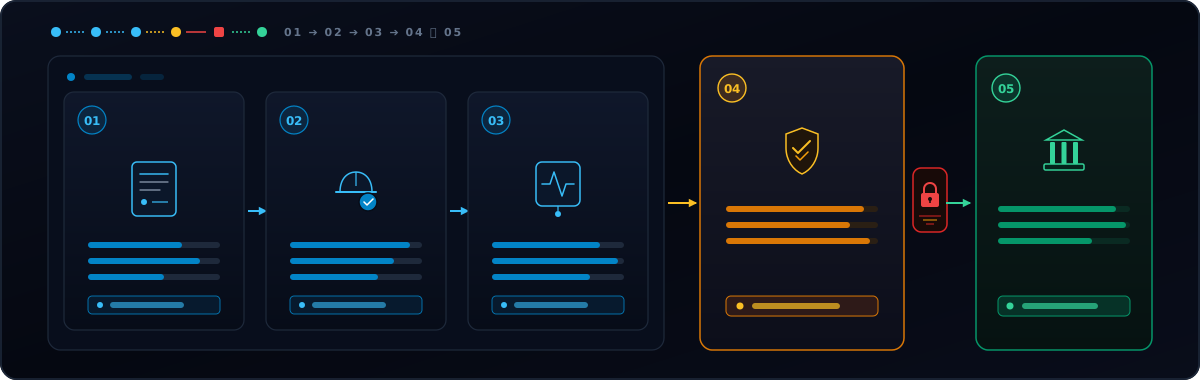
Physical engineering tranches and contractual safeguards (Didactic Example):
- T1: 25%PV Modules & Inverters SupplySupply & Customs
Siscomex customs clearance (DI/Duimp), commercial invoices, Bill of Lading (BL), entry NF-e records for 90,000 bifacial panels and 10 central inverters with georeferenced serial sampling.
- T2: 25%Civil Works, Pile Driving & TrackersCivil & Geotechnical
Topographic GNSS RTK survey, geotechnical pile pull-out tests (pursuant to project engineering specifications and certified CREA ART), and aerial drone photogrammetry.
- T3: 25%Electromechanical Assembly CC/CAElectromechanical & NBR
DC string cabling, AC feeders, combiner boxes, and electrical testing pursuant to ABNT NBR 16690:2019 and ABNT NBR 16274:2014 (insulation resistance R-iso and I-V curves) with CREA ART.
- T4: 25%Substation 34.5/230 kV & Grid InterconnectionSubstation & Grid/ONS
Energization of the step-up transformer, SCADA telemetry integration, protection relay testing, and compliance with the ONS CUST transmission agreement for connection to the SIN.
- 05Settlement Channel / Contracted CustodianContracted Institution
Formal private administrative order dispatched exclusively to the contracted regulated partner financial institution for release from a segregated escrow account. Note: step 05 is neither a fifth tranche nor a fifth disbursement, but the banking settlement channel for the 4 physical engineering tranches (where applicable, an authorized institution in the relevant jurisdiction).
If inspection reports identify non-critical Level 2 punch-list snags, the contract may stipulate a precautionary 5% to 10% retention of tranche funds in a segregated sub-account until technical remedy; no funds are disbursed automatically.
Regulatory safeguard: Illustrative didactic example. The 25% tranches and plant parameters simulate typical market models. Venko Total Group acts exclusively in technical coordination and documentary milestone governance, without custody of funds or execution of banking activities.
1. Civil Contractors and Equipment Manufacturers: Submission of field progress certificates, electronic tax invoices (NF-e), raw material mill test certificates, and labor clearance declarations;
2. Independent Owner's Engineer: On-site inspection testing, FAT/SAT auditing, and formal sign-off of Milestone Completion Certificates with statutory engineering liability;
3. Venko Total Group (Evidentiary Proof Software): Cryptographic orchestration of audit trails, verification of ANEEL/ANA conditions precedent, Maker-Checker sign-off validation, and automated release instructions;
4. Escrow Bank / Settlement Agent: Strictly conditional fund release from segregated accounts upon verification of ledger-anchored certificates, maintaining complete bankruptcy remoteness between project assets, sponsors, and lenders.
Glossary
Frequently Asked Questions (FAQ)
1. What is the regulatory distinction between an SHP and a CGH under ANEEL?
A Hydroelectric Generating Unit (CGH) has an installed capacity of up to 5 MW and benefits from simplified registration with ANEEL. A Small Hydropower Plant (SHP) has a capacity between 5 MW and 30 MW and reservoir area up to 13 km², requiring formal authorization based on an approved Basic Design under ANEEL Normative Resolution No. 875/2020.
2. Why is river diversion considered the most critical civil milestone?
Because constructing cofferdams and diversion tunnels exposes the site directly to uncontrolled river discharge. Unexpected hydrological flood peaks during diversion can wash out temporary structures, flood foundation pits, and cause months of construction delays and severe budget overruns.
3. How do ANA and state water grants protect the project investment?
Water grants legally secure water intake and turbine diversion rights for fixed periods (typically 35 years). This provides vital legal security against upstream competing projects that could otherwise deplete or divert flows needed to meet the $Q_{95}$ flow-duration curve and certified physical guarantee.
4. What role does the escrow account play with turbine manufacturers?
Heavy equipment manufacturers demand upfront cash advances during factory fabrication. Depositing funds into segregated escrow accounts ensures disbursements occur only upon independent Owner's Engineer certification that FAT tests comply with contractually guaranteed efficiency and cavitation benchmarks.
5. What happens if the SHP fails to obtain the Operating License (LO) on schedule?
Without an Operating License (LO), the reservoir cannot be impounded and commercial operations cannot commence. This stalls cash generation, delays PPA power deliveries, and exposes the SPE to severe CCEE and ANEEL delay fines. For this reason, environmental compliance is tracked as an ongoing condition precedent across all CAPEX tranches.
Conclusion: engineering as the guarantor of fiduciary integrity
The financial viability and investment security of Small Hydropower Plants do not rest solely on river hydrology or high-efficiency turbine engineering. Long-term success relies upon governance discipline connecting on-site construction realities to capital market fiduciary protections.
By conditioning disbursements on independently verified technical milestones, segregating civil works from equipment procurement, and validating compliance with ANA and ANEEL permits, this fiduciary framework transforms site construction uncertainty into institutional surety, safeguarding capital and powering sustainable energy infrastructure in Brazil.
Intelligence Report Conclusions & Release Governance
- •Full Regulatory Compliance: Complete alignment with Federal Procurement Law 14,133/2021, Law 13,303/2016, and federal audit standards (CGU/TCU).
- •Canonical Segregation & Zero-Custody: Strict boundary between analytical evidence coordination and regulated banking custody.
- •Immutable Cryptographic Integrity: Audited envelope with SHA-256 canonical digest and full traceability via RFC 8785.
- •Fail-Closed Shielding: Operation strictly constrained in production environments with full quorum of validated gates.