
The full enforcement of Brazil's New Public Bidding and Administrative Contracts Law (Federal Law No. 14,133/2021) has transformed compliance and operational governance standards for corporate consortia and suppliers contracting with the public sector (B2G).
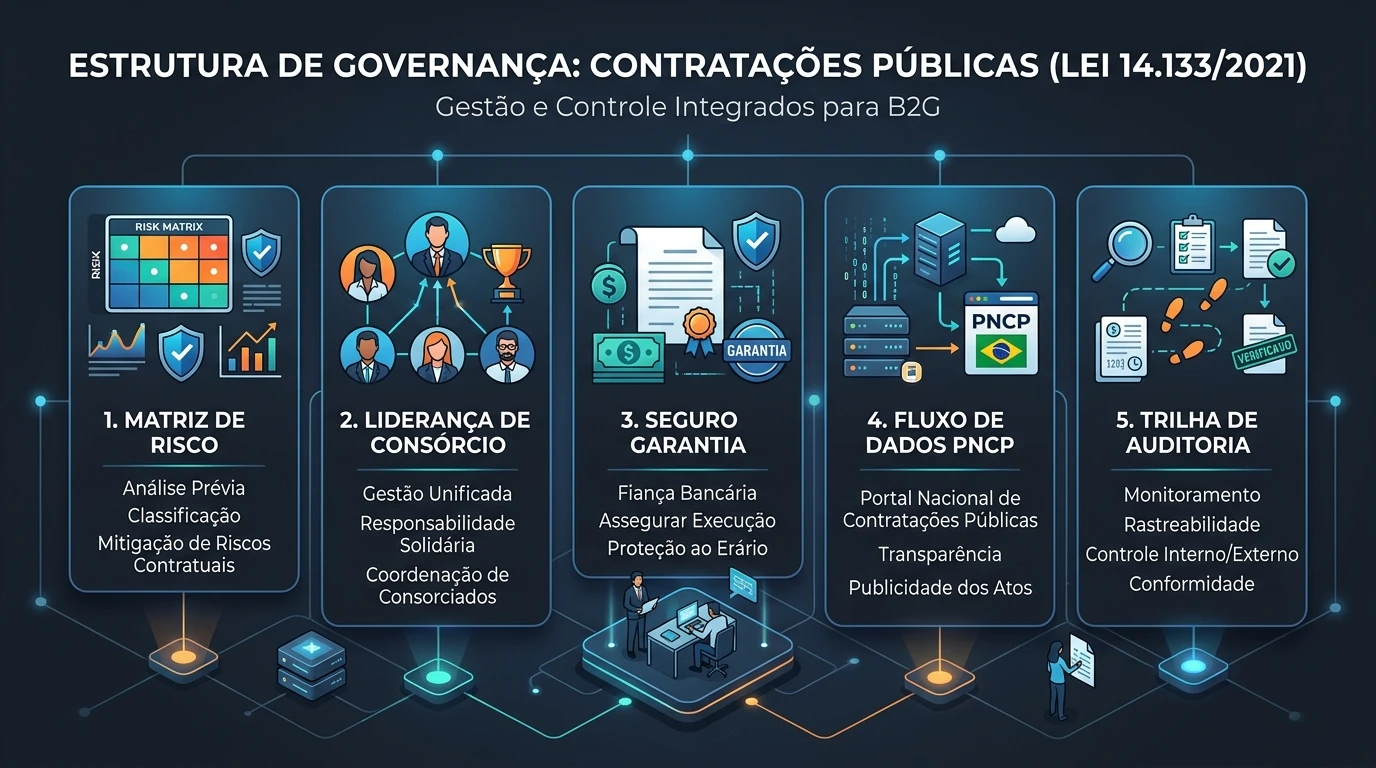
Far from a minor procedural update to the repealed Law 8,666/1993, this statutory framework establishes three mandatory operational pillars: risk allocation matrices, surety bonds with step-in rights (insurer's right to take over and resume the works) for insurers, and formal joint liability governance in consortia.
For procurement committees, general counsels, and infrastructure consortia, manual spreadsheet management has become an unacceptable operational risk given concurrent audits by the Federal Court of Accounts (TCU) and State Audit Courts (TCEs).
B2G Legal Disclaimer (Clause A): The Venko Procurement Radar serves as an auxiliary business intelligence tool. Official publications in the National Public Procurement Portal (PNCP) and official government gazettes are the sole primary sources endowed with public faith for statutory deadlines, administrative challenges, and appeals. Geospatial and visual representations provide educational and analytical context only, not legal evidence or outcome guarantees.
Regulatory Tripod of Law 14,133/2021 for B2G Consortia
Risk mitigation in large-scale public contracts demands adherence to specific statutory provisions:
Consortia Governance and Joint Liability (Art. 15):
Article 15 sets parameters for joint ventures and bidding consortia:
- Consortium Constitution Undertaking: Presentation of formal documentation designating the lead company fulfilling tender leadership criteria.
- Joint and Several Liability: All consortium members are jointly liable for actions during bidding and execution.
- Duplicity Prohibition: A single entity cannot participate in multiple consortia within the same tender.
Performance Bonds with Step-In Rights (Art. 102):
For large-scale engineering contracts exceeding BRL 200 million, tenders may require surety bonds covering up to 30% of total contract value with insurer takeover clauses:
- In default scenarios, the insurer assumes direct construction completion or indemnifies the public entity.
- Insurers authorized by SUSEP require verifiable, timestamped physical-financial measurement reports.
Risk Allocation Matrix (Art. 103):
Contracts establish objective risk distribution between public and private partners—covering environmental licensing delays, foreign exchange swings, and right-of-way expropriations—preserving economic equilibrium from inception.
B2G Radar and Tender Intelligence (Official Sources & PNCP Priority)
Venko B2G organizes tender intelligence through an integrated tracking dashboard under the primacy of official publications:
Primacy of Official Primary Sources & Sync Latency:
- National Public Procurement Portal (PNCP): Structured ingestion via the official API v1 under Art. 174 of Law 14,133/2021 (Inspect Official Notices on PNCP), with business-day synchronization and typical operational latency up to 24 business hours.
- Federal, State, and Municipal Official Gazettes: Automated aggregation across 26 states, the Federal District, state capitals, and municipalities with open machine-readable gazettes.
- Educational Nature of Geospatial Signals: Cartographic layers serve strictly as analytical context. They do not constitute real-time physical monitoring or judicial evidence.
- Limitations and Exclusions: National security procurements (Art. 75, IV), classified military purchases, and judicial secrecy proceedings are categorically excluded. Direct consultation with primary sources remains mandatory.
Document Consistency and Pre-Qualification:
The platform supports consortia in cross-referencing corporate credentials, federal tax clearances (CNDs), and technical capacity certificates prior to submission, reducing formal disqualification risks.
Evidence Governance and Maker-Checker Audit Trail
Operational Matrix: From Notice to Contract Execution
✅ When the Platform Is Recommended::
- Engineering and infrastructure consortia entering municipal, state, or federal tenders.
- Suppliers managing multiple public contracts requiring centralized compliance alerts.
- Projects requiring transparent audit trails for external audit courts and independent verifiers.
- Document coordination supporting surety insurers with step-in right policies.
❌ When the Platform Is NOT Recommended::
- Direct low-value micro-procurements without guarantee or consortium requirements.
- Legal advocacy and contested administrative defense: Venko does not file legal motions or tender appeals, which are reserved for qualified legal counsel.
- Financial custody or fund escrow: The platform is not a bank or payment institution; it does not hold cash guarantees, settle public invoices, or issue surety bonds. All financial settlements and guarantees are executed by licensed banking institutions and regulated insurers.
Eligibility Scope: When Venko Is Recommended
Middle-of-Funnel: Technical Materials:
Review statutory documentation requirements before submitting bids:
Bottom-of-Funnel: Consortium Operational Onboarding:
If your consortium has identified targets and needs to structure compliance workflows:
Operational Journey and Consortium Qualification Funnel
Three-Dimensional Eligibility Funnel & Public Opportunity Radar
Sub-100ms analytics over Brazilian Federal Revenue (RFB), SIAFI, and National Public Procurement Portal (PNCP / Law 14,133/2021)
55,000,000+ Historical Registry Records (RFB)
National corporate database covering all commercial entities registered throughout Brazilian economic history.
23,000,000+ Active Legal Entities (Status 02)
Strict registration status filter: isolating active businesses while purging dissolved, suspended, or barred entities.
~8,000,000 Eligible Suppliers ("Blue Ocean")
Active solvent enterprises meeting balance sheet criteria: Paid-in Capital >= 10%, clean debarment status (CEIS/CNEP/CEPIM/TCU), and compliant tax clearances.
Reverse Matchmaking & Strategic Consortia
Highly solvent industrial and technology firms that rarely bid on public tenders due to perceived bureaucratic friction.
- Reverse activation triggered directly by published PNCP tenders
- Consortia structuring under Article 15 of Federal Law 14,133/2021
- Preserved gross margins with superior technical delivery rates
- Contractual safeguarding with performance bonds and digital oversight
Conventional Auctions & Destructive Price Wars
Narrow pool of recurrent government bidders engaged in predatory auctions with razor-thin margins.
- Destructive penny wars yielding unviable project economics
- Hyper-compressed margins driving execution defaults and delays
- Protracted administrative appeals and ongoing legal disputes
- Elevated project failure rates and public contract sanctions
Corporate registry and procurement records originate exclusively from official open government sources (RFB, PNCP, SIAFI), parsed in strict accordance with LGPD data protection rules. Venko provides neutral market intelligence and does not guarantee contract awards.
What is the geographic coverage of the tender radar?:
The radar monitors the official API v1 of the National Public Procurement Portal (PNCP), the Federal Official Gazette (DOU), 26 State Gazettes, the Federal District, and indexed municipalities with open digital gazettes. Sync occurs on business days within a 24-business-hour window. Official gazettes and the PNCP represent the sole legally authoritative sources.
Does Venko issue or broker performance bonds?:
No. Venko Total Group is not an insurance broker or surety insurer. Our technology standardizes milestone reporting and documentation so consortia can substantiate compliance before SUSEP-authorized insurers.
How does the platform maintain neutrality among consortium members?:
Through role-based access control (RBAC) and dual-signature approval workflows (Maker-Checker), keeping sensitive bidding data partitioned according to consortium confidentiality agreements.
Frequently Asked Questions (FAQ)
What is the geographic coverage of the tender radar?
The radar monitors the official API of the National Public Procurement Portal (PNCP / Art. 174 of Law 14,133/2021), the Federal Official Gazette (DOU), and the official gazettes of all 26 Brazilian States and the Federal District, maintaining the evidentiary supremacy of primary official records.
Does Venko issue or broker performance bonds?
No. Venko Total Group is not an insurance company or broker. Our platform standardizes engineering measurement reports and milestone evidence so consortia can verify compliance before SUSEP-authorized insurers.
How does the platform maintain neutrality among consortium members?
Through strict role-based access control (RBAC) and dual-control maker-checker workflows, ensuring proprietary business data of each consortium member remains segregated and protected.
What is the ingestion frequency and update window for PNCP notices?
Data ingestion operates automated daily sync cycles during business days, ensuring amendments, clarification notices, and suspension alerts are indexed promptly.
How does the platform support compliance with TCU Ruling 2,622/2015?
The platform structures the contractual risk allocation matrix mandated by TCU jurisprudence, enabling objective tracking of operational liabilities.
Related Resources & Primary Sources
Intelligence Report Conclusions & Release Governance
- •Full Regulatory Compliance: Complete alignment with Federal Procurement Law 14,133/2021, Law 13,303/2016, and federal audit standards (CGU/TCU).
- •Canonical Segregation & Zero-Custody: Strict boundary between analytical evidence coordination and regulated banking custody.
- •Immutable Cryptographic Integrity: Audited envelope with SHA-256 canonical digest and full traceability via RFC 8785.
- •Fail-Closed Shielding: Operation strictly constrained in production environments with full quorum of validated gates.