
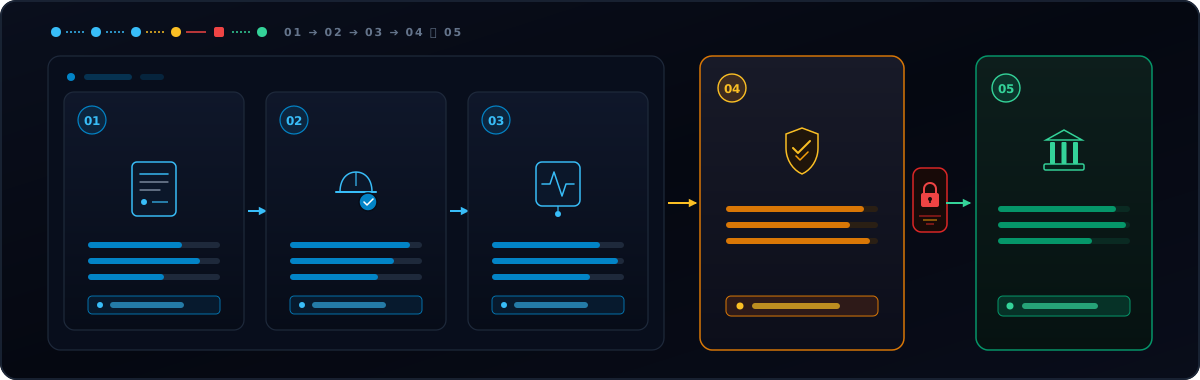
How to check milestones before disbursement on clean energy projects? In energy transition projects — such as photovoltaic solar complexes, wind farms and green hydrogen plants — the release of capital contributions requires an auditable process of documentary and expert evidence. To eliminate mismatches between financial progress and actual physical completion, technical verification is structured in a flow of five sequential steps:
1. Constitution of the Physical-Documental Dossier: The executor of the work (EPC contractor) consolidates commercial invoices, electronic invoices (NF-e), import customs clearance (DI/Duimp) and geotechnical and civil records;
2. Independent Technical Attestation: An Independent Verifying Engineer (Owner's Engineer), duly registered with CREA/CONFEA, carries out on-site inspection in the field, performs standardized tests and issues the respective Technical Responsibility Note (ART);
3. Sample Telemetric Synchronization: Periodic collection of data from central inverters, solar trackers (trackers), solarimetric/anemometric stations and SCADA supervisory to verify the operational readiness of the subsystems;
4. Maker-Checker Fiduciary Governance: Independent comparison of the physical dossier with the contractual disbursement clauses, evaluating non-conformities and residual pending issues (punch list);
5. Conditioned Banking Instruction: Dispatch of the private administrative order to the partner financial institution authorized by the Central Bank of Brazil (BACEN), which holds the resources in a linked account (escrow) and carries out the financial settlement.
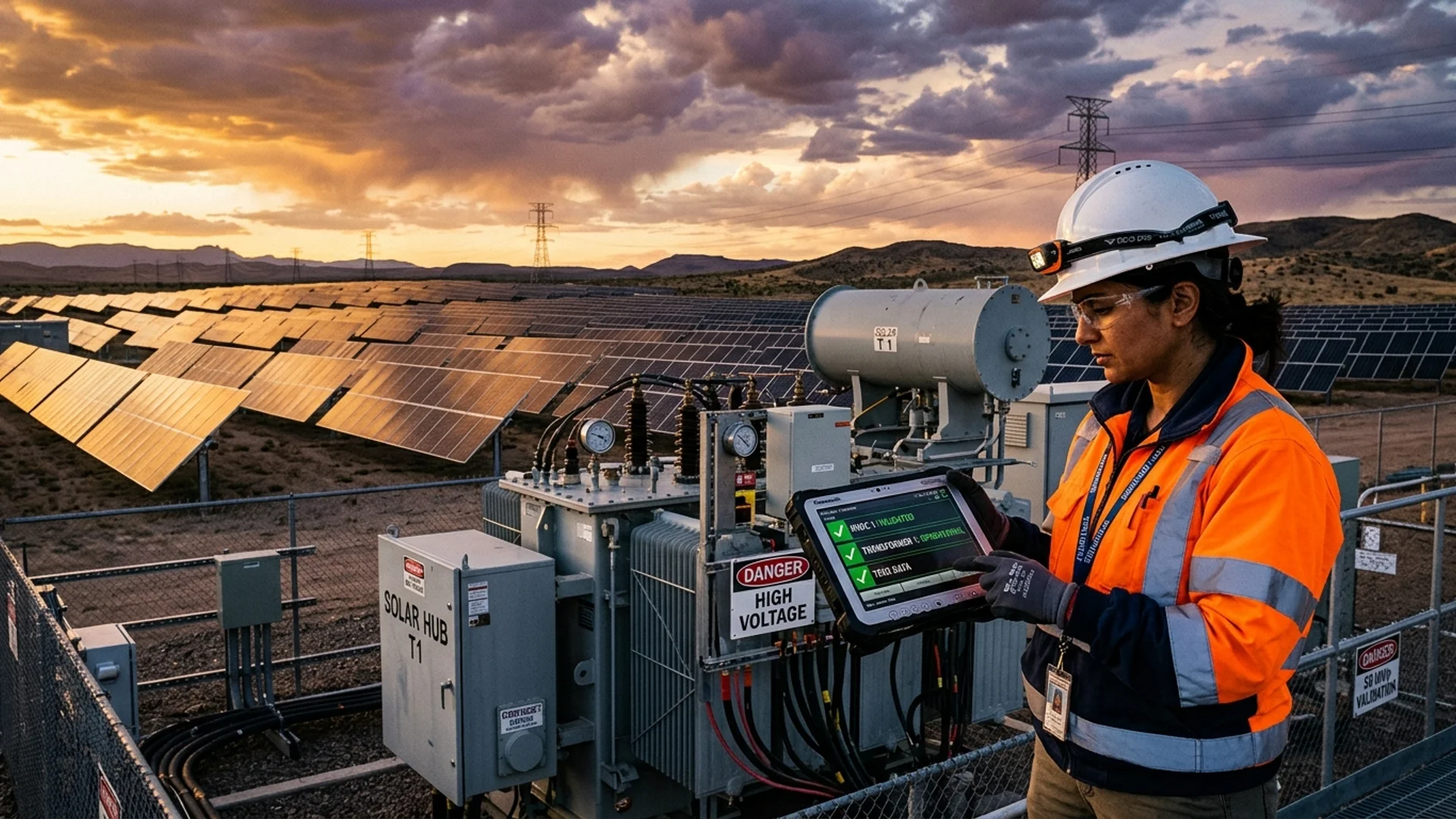
Engineering Pipeline, Physical Milestones & Disbursement Safeguards
Illustrative simulation of a 50 MWp solar plant: physical field verifications (modules, pile driving, ABNT NBR 16690, and 34.5/230 kV substation) as evidentiary inputs for escrow accounts
Horizontal Segregation of Roles & Governance Barriers Flowchart
Strict segregation between physical site execution, technical sign-off, software orchestration, and banking settlement
EPC Contractor
Consolidation of commercial invoices, entry NF-e records, Siscomex customs clearance (DI/Duimp), and physical construction logs.
Independent Owner's Eng.
On-site field inspection, ABNT NBR 16690 & 16274 testing, and statutory CREA Anotação de Responsabilidade Técnica (ART).
Venko Total Group
Dossier orchestration, cryptographic SHA-256 audit hashing, two-party Maker-Checker governance, and private instructions.
Regulated Escrow Bank
Administration of the segregated escrow bank account and final tranche fund release under Central Bank supervision.
Physical engineering tranches and contractual safeguards (Didactic Example):
- T1: 25%PV Modules & Inverters SupplySupply & Customs
Siscomex customs clearance (DI/Duimp), commercial invoices, Bill of Lading (BL), entry NF-e records for 90,000 bifacial panels and 10 central inverters with georeferenced serial sampling.
- T2: 25%Civil Works, Pile Driving & TrackersCivil & Geotechnical
Topographic GNSS RTK survey, geotechnical pile pull-out tests (pursuant to project engineering specifications and certified CREA ART), and aerial drone photogrammetry.
- T3: 25%Electromechanical Assembly CC/CAElectromechanical & NBR
DC string cabling, AC feeders, combiner boxes, and electrical testing pursuant to ABNT NBR 16690:2019 and ABNT NBR 16274:2014 (insulation resistance R-iso and I-V curves) with CREA ART.
- T4: 25%Substation 34.5/230 kV & Grid InterconnectionSubstation & Grid/ONS
Energization of the step-up transformer, SCADA telemetry integration, protection relay testing, and compliance with the ONS CUST transmission agreement for connection to the SIN.
- 05Settlement Channel / Contracted CustodianContracted Institution
Formal private administrative order dispatched exclusively to the contracted regulated partner financial institution for release from a segregated escrow account. Note: step 05 is neither a fifth tranche nor a fifth disbursement, but the banking settlement channel for the 4 physical engineering tranches (where applicable, an authorized institution in the relevant jurisdiction).
If inspection reports identify non-critical Level 2 punch-list snags, the contract may stipulate a precautionary 5% to 10% retention of tranche funds in a segregated sub-account until technical remedy; no funds are disbursed automatically.
Regulatory safeguard: Illustrative didactic example. The 25% tranches and plant parameters simulate typical market models. Venko Total Group acts exclusively in technical coordination and documentary milestone governance, without custody of funds or execution of banking activities.
Responsibility and Limits Matrix: Who Decides What
The integrity of fiduciary governance in infrastructure projects requires strict clarity about the responsibilities of each entity involved. Verifying technical compliance with an engineering milestone is not equivalent to approving credit, holding monetary resources, issuing a payment order or guaranteeing the result of a disbursement.
Distinction of Capabilities: What Venko Proposes vs. What Does Venko Propose? Offers Today vs. Depends on Third Parties
To protect investors and creditors against false operational expectations, it is imperative to rigorously distinguish the technological scope of Venko Total Group:
- What Venko offers today: A B2B software platform for orchestrating evidentiary dossiers, indexing expert reports with a cryptographic time stamp (SHA-256), control of authority levels in a collegiate two-phase flow (Maker-Checker) and reconciliation of contractual conditions precedent.
- What Venko conceptually proposes: A neutral operational coordination architecture that synchronizes field industrial telemetry and tax/customs documentation with contractual release triggers for linked accounts, reducing the risk of payment for incomplete works.
- Which depends on contract, integration or third party:
- *Escrow Accounts (Escrow):* Opening, custody and movement of escrow accounts result from specific banking contracts signed directly between project sponsors and financial institutions duly authorized by the Central Bank of Brazil (in Brazil) or under local regulatory jurisdictions in cross-border operations. Venko does not store or handle funds.
- Technical Reports and Attestations: Field verification depends on the formal hiring of consulting engineering companies qualified by CREA/CONFEA, under the issuance of a Technical Responsibility Note (ART).
- Credit Approval: Decisions to grant, renew or accelerate credit are the exclusive responsibility of the financiers' risk committees and the fiduciary agents that represent debenture holders within the scope of Federal Law nº 12,431/2011.
Rigorous Technical Definitions of Architecture
1. WORM Trail and Cryptographic Hashing: When contracted and configured in the applicable project environment, retention policies can adopt WORM (Write Once, Read Many) with Object Lock in compliance mode (compliance mode) and cryptographic chaining via SHA-256 hash to support evidentiary traceability. The calculation of SHA-256 hashes allows you to detect divergences or changes in the file when compared to the original reference record; it does not in itself attest to the prior intrinsic veracity of the documentary content nor does it replace identity controls, authorization and access segregation.
2. Periodic and Sensory Telemetry (Not Absolute "Real Time"): Data synchronization from photovoltaic and wind plants operates by periodic sampling (configurable intervals of 5 to 60 minutes) from central inverters, irradiance sensors, anemometers and SCADA supervisory systems. The model incorporates tolerance windows and local redundancy protocols to accommodate common telecommunications outages in remote site regions.
3. Conditioned Operating Instruction and Segregation of Duties: There is no automatic disbursement or disbursement without qualified human intervention. Each private instruction dispatched to the financial institution requires documentary validation from the technical analyst (Maker) and formal approval from an independent governance authority (Checker). This segregation is supported by effective governance controls: users with different credentials, strict prohibition of self-approval, authority parameterized by value and stage, indelible record of timestamps, formal justifications and access revocation policies. Collegiate approval formalizes the procedural compliance of the dossier, without implying a judgment on the merits of credit risk or liquidity guarantee.
Didactic Operational Example: 50 MWp Solar Photovoltaic Complex
Methodological Note and Illustrative Example: Illustrative example. Percentages, documents, acceptance criteria, sampling, retention and those responsible must be defined in the contract, inspection plan and financing package applicable to the project. The values and tranches below simulate common market parameters and do not represent imposing requirements or mandatory standardization by Venko Total Group.
To illustrate the practical application of operational safeguards, analyze a didactic simulation of the implementation of a 50 MWp solar photovoltaic complex under Centralized Generation (GC) in the Brazilian semi-arid region. As a modeling hypothesis for this illustrative example, the project is governed by the ANEEL authorization regime (Federal Law nº 9,074/1995 and Federal Law nº 9.427/1996), with access and connection to the National Interconnected System (SIN) considered within the scope of transmission through an Access Opinion and Transmission System Use Contract (CUST) signed with the National Electric System Operator (ONS), financed via the issuance of Incentive Debentures of Infrastructure (Federal Law nº 12,431/2011) and with a linked account maintained at a banking institution authorized by the Central Bank of Brazil (Federal Law nº 4,595/1964):
Exception Handling, Punch Lists and Divergence Governance
On large construction sites, technical divergences and partial delays are normal occurrences. The contractual governance design must provide objective mechanisms to deal with these complications without unjustifiably paralyzing the project or exposing creditors to undue risks:
1. *Strict Punch Classification (Punch List):*
- Impeditive Nonconformity (Level 1): Critical failures that compromise physical safety, electrical insulation (non-compliance with ABNT NBR 16690) or tax/customs regularity. The release instruction remains fully retained until correction and new inspection.
- Non-Impeditive Residual Pending (Level 2): Lower impact adjustments (e.g.: closing secondary channels or recomposing gravel). In these cases, the contract may provide for the release of the portion with proportional technical retention (e.g.: 5% to 10% of the value of the tranche) deposited in a linked subaccount until the pending list is resolved.
2. Technical Counter-Inspection Procedure: If the contractor disputes the Independent Verifier's report, the operational regulations stipulate that a joint expert counter-inspection will be carried out within a pre-agreed period (e.g.: 5 working days). The costs of extraordinary expertise fall on the losing party in the technical investigation.
3. Contingency for Telemetry Unavailability: If data connection failures occur at the site, commissioning reports issued in person by accredited experts, endorsed with a qualified digital signature (ICP-Brasil), temporarily supply the remote sensor feeds.
4. *Suspension Prerogative (Preventive Stop-Order): The platform's Governance Checker, the independent auditor or the Fiduciary Agent have the authority to issue a preventive blocking order (Stop-Order*) at any time prior to the bank order if signs of serious environmental liabilities, work accidents with interdiction or registration disputes arise.
5. Post-Settlement Financial Irreversibility: Once the transfer has been processed by the regulated custodian bank, the resources leave the sphere of the linked account. For this reason, evidentiary validation controls must be exhaustive prior to sending the instruction, as subsequent reversal depends exclusively on arbitration or judicial litigation.
Antigreenwashing Guidelines and Rigor in Socio-Environmental Claims
In the sustainable investment ecosystem, the integrity of institutional communication is a fiduciary asset. In compliance with the CONAR Brazilian Code of Advertising Self-Regulation (Annex V - Sustainability Appeals) and the guidelines of the Global Guide of the Brazilian Association of Advertisers (ABA / WFA) on socio-environmental allegations:
- Descriptive Accuracy: The use of the expression "clean energy" refers exclusively to the technological nature of renewable sources of primary generation (solar radiation, wind power and water resources), not constituting a promise of unrestricted climate neutrality or the absence of socio-environmental impacts in the civil works phase.
- Prohibition of Generic Decarbonization Claims: The operation of the coordination platform focuses strictly on the physical management of engineering works. It does not certify carbon credits or guarantee environmental offsets for corporate compensation for Greenhouse Gas (GHG) emissions.
- Measurement, Reporting and Verification (MRV) Methodology for Climate Benefits: Any formal calculation of avoided emissions must be conducted under Measurement, Reporting and Verification (MRV) methodologies accepted by the GHG Protocol or registered with accredited third-party certifying bodies (e.g.: I-REC, Verra VCS or Gold Standard), with validation reports issued by independent Validation and Verification Bodies (VVB).
Coordination of Milestones in Renewable Energy Projects
Learn about document integration flows, regulated linked account requirements and evidence matrices for solar plants and wind farms.
Request Operational Coordination Assessment | Get to know the Energy and Infrastructure Division
Frequently Asked Questions (FAQ)
Does verification of an engineering milestone guarantee credit approval or financial disbursement?
No. Technical verification only certifies that a certain construction stage was carried out in accordance with the engineering specifications and supporting documents presented. The financial release decision arises from the private contractual terms agreed between creditors, investors and the project sponsor, with credit approval being the responsibility of the competent committees and monetary execution being the responsibility of the banking institution that manages the linked account.
Does Venko Total Group act as a banking institution or custodian of resources?
No. Venko Total Group is a technology developer and neutral operational coordinator of engineering and governance data. The financial resources of each project remain fully in custody in linked bank accounts (escrow), managed directly by financial institutions duly authorized by the Central Bank of Brazil or by the competent regulatory bodies in the applicable jurisdiction.
What happens when imported equipment arrives late or damaged at the site?
The governance model segregates the analysis into two fronts: if essential equipment (such as solar modules or central inverters) presents faults that prevent technical compliance, the corresponding milestone is not certified and the bank instruction is withheld. In the case of partial delivery with damaged secondary components, the contract may allow partial approval with a discount on the technical warranty retention (punch list), protecting the capital until replacement by the manufacturer.
How does Maker-Checker governance protect investors in infrastructure bonds?
The Maker-Checker flow aims to mitigate monocratic decisions through systematic segregation between those who prepare and those who validate. A technical analyst (Maker) consolidates reports with ART and inspections, while an independent governance authority (Checker) checks legal and documentary compliance. When contracted and configured in the applicable environment, this routine associates records with integrity and temporal retention policies (such as WORM/Object Lock), allowing the Debenture Holders' Fiduciary Agent to audit the steps with structured traceability and a verifiable document trail.
Normative basis and legislative references: Federal Law nº 4,595/1964 (Structure of the National Financial System); Federal Law No. 12,431/2011 (Incentive Debentures for Infrastructure); Federal Law No. 9,074/1995 (Grants and Concessions Regime for the Electric Sector); Federal Law No. 9,427/1996 (Institution of ANEEL and Regulation of the Electric Sector); ONS Network Procedures (Basic Network Access and Operation Submodules); Standard ABNT NBR 16690:2019 (Electrical Installations of Photovoltaic Arrangements); Standard ABNT NBR 16274:2014 (Photovoltaic Systems Connected to the Grid - Commissioning and Inspection Tests); CONAR Brazilian Code of Advertising Self-Regulation (Annex V - Sustainability Appeals); ABA/WFA Global Sustainability Guide.
Note on Normative Context and Institutional Transparency: Technical article produced by the Infrastructure and Energy Transition Division of Venko Total Group based on fiduciary engineering models and private operational coordination. Mentions of legal provisions (such as Law No. 4,595/1964, Law No. 12,431/2011, Law No. 9,074/1995 and Law No. 9,427/1996) and regulatory entities such as ANEEL, ONS, CONAR, Federal Revenue and ABNT constitute contextual references of the Brazilian regulatory framework applicable to the electrical and financial sector, not constituting regulatory approval, official approval or accreditation of such bodies to Venko's software solutions. The fiduciary compliance of each operation depends on individual legal and technical analysis of the project contract. Institutional Technical Review: Venko Total Group Engineering and Operations Team. Regulatory Review: Compliance and Fiduciary Governance Advice. Published on September 29, 2026.
Intelligence Report Conclusions & Release Governance
- •Full Regulatory Compliance: Complete alignment with Federal Procurement Law 14,133/2021, Law 13,303/2016, and federal audit standards (CGU/TCU).
- •Canonical Segregation & Zero-Custody: Strict boundary between analytical evidence coordination and regulated banking custody.
- •Immutable Cryptographic Integrity: Audited envelope with SHA-256 canonical digest and full traceability via RFC 8785.
- •Fail-Closed Shielding: Operation strictly constrained in production environments with full quorum of validated gates.