
How to verify milestones before a capital disbursement in clean energy projects? In energy transition developments — such as utility-scale photovoltaic complexes, wind farms, and green hydrogen facilities — the release of equity and debt tranches requires an auditable process of documentary and expert verification. To eliminate discrepancies between recorded financial expenditure and actual physical completion on site, technical verification follows five sequential steps:
1. Physical-Documentary Dossier Compilation: The engineering, procurement, and construction (EPC) contractor consolidates commercial invoices, tax receipts (electronic NF-e), customs clearance documentation for imported equipment (DI/Duimp), and geotechnical civil records;
2. Independent Technical Attestation: An accredited Independent Verifying Engineer (Owner's Engineer), registered with the engineering council (CREA/CONFEA), conducts an on-site physical inspection, performs standardized electrical and civil tests, and issues the statutory Technical Responsibility Note (ART);
3. Periodic Sampled Telemetry: Systematic data harvesting from central inverter clusters, tracking controllers, solarimetric/anemometric weather stations, and SCADA supervisory software to ascertain the operational readiness of completed subsystems;
4. Maker-Checker Fiduciary Governance: Objective cross-examination of the physical evidence dossier against contractual conditions precedent, classifying exceptions and residual punch list items;
5. Conditioned Banking Instruction: Dispatch of the private administrative instruction to the partner banking institution authorized by the Central Bank of Brazil (BACEN), which maintains the segregated linked account (escrow) and executes the monetary settlement.
Milestone Coordination Pipeline & Disbursement Safeguards
Strict segregation between field engineering evidence, maker-checker governance, and regulated banking execution
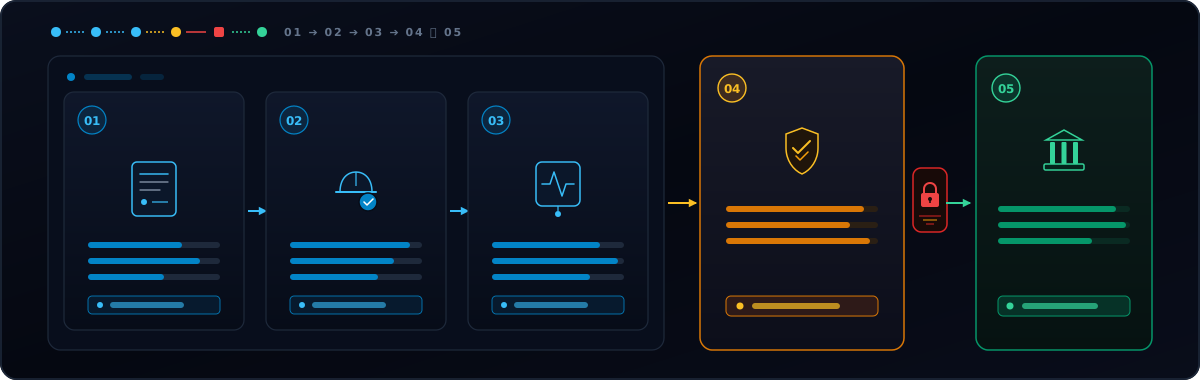
Detailed operational workflow steps:
- 01.EPC Material DossierField & Siscomex
Fiscal records (commercial invoices, DI/Duimp in Siscomex), geotechnical soil tests, and serial-number sampling with georeferenced photos.
- 02.Independent ART AttestationOwner's Engineer
In-person on-site inspection and formal technical attestation accompanied by an official ART (CREA) issued by an independent Owner's Engineer.
- 03.SCADA TelemetryIndustrial Sampling
Periodic sensory sampling of electrical isolation and inverter operational parameters with offline buffering tolerance for remote plants.
- 04.Maker-CheckerVenko Platform
Two-party corporate sign-off on the Venko platform: verification of financing loan covenants and punch-list holdback retention.
- 05.Custodian / BankContracted Institution
Formal conditional settlement instruction transmitted to the contracted financial or custodian institution for release from segregated project accounts (where applicable, an authorized institution in the relevant jurisdiction).
Regulatory safeguard: Venko Total Group acts exclusively as an operational workflow coordinator and neutral audit ledger, without holding fund custody or conducting regulated banking activities.
Responsibility & Boundary Matrix: Who Decides What
Maintaining fiduciary integrity across complex energy infrastructure requires strict clarity regarding institutional boundaries. Verifying the engineering completion of a construction milestone is not equivalent to approving credit, holding monetary custody, issuing payment orders, or guaranteeing disbursement outcomes.
Scope Distinction: What Venko Proposes vs. Delivers Today vs. Relies on Third Parties
To safeguard investors and lenders against operational ambiguity, institutional boundaries must be delineated with absolute clarity:
- What Venko provides today: A specialized B2B software platform for orchestrating evidential dossiers, indexing inspection reports with SHA-256 cryptographic timestamps, enforcing dual-operator approval alçadas (Maker-Checker), and auditing conditions precedent.
- What Venko proposes conceptually: A neutral coordination architecture that bridges field industrial telemetry, fiscal/customs documentation, and private escrow release triggers, minimizing the risk of misallocated capital.
- What strictly depends on contracts, integrations, or third-party institutions:
- Linked Escrow Accounts: Account opening, balance custody, and monetary wire transfers are governed by dedicated banking contracts executed directly between project sponsors and licensed banking institutions authorized by the Central Bank of Brazil (BACEN) or competent regional regulators. Venko neither holds custody nor transfers funds.
- Engineering Inspection Reports: Field verification requires formal engagement of certified consulting engineering firms registered with CREA/CONFEA issuing statutory ART certificates.
- Credit Decisions: Granting, amending, or accelerating debt facilities belongs exclusively to lenders' credit risk committees and bondholder indenture trustees governed by Brazilian Infrastructure Debenture Law (Law No. 12,431/2011).
Architectural Definitions & Technical Safeguards
1. WORM Trail & Cryptographic Hashing: When contracted and configured in the applicable project environment, retention policies may employ WORM (Write Once, Read Many) cloud storage with Object Lock in compliance mode and SHA-256 cryptographic hashing to support evidential traceability. SHA-256 hashing allows detection of unauthorized modifications when compared against the original reference record; it does not in itself guarantee the prior intrinsic truthfulness of the underlying document, nor does it replace identity governance, access authorization, or duty segregation controls.
2. Periodic & Sampled Telemetry (Not Absolute Real-Time): Data collection from solar arrays and wind turbines operates on periodic intervals (configurable from 5 to 60 minutes) from central inverters, irradiance sensors, anemometers, and SCADA monitoring systems. The architecture incorporates local buffering and tolerance windows to handle communication outages common in remote construction environments.
3. Conditioned Operational Instructions & Segregation of Duties: No disbursement is automated or executed without qualified human verification. Every private administrative instruction dispatched to the banking institution requires documentary validation by a technical analyst (Maker) and formal authorization by an independent governance authority (Checker). This segregation relies on robust controls: separate user credentials, strict prohibition of self-approval, parameterized approval thresholds by milestone value, immutable timestamped audit logs, recorded justifications, and credential revocation policies. Dual approval formalizes procedural compliance without constituting credit underwriting or liquidity guarantees.
Illustrative Operational Example: 50 MWp Utility-Scale Solar Complex
Methodological Note & Illustrative Example: Illustrative example. Percentages, documentation, acceptance criteria, sampling rates, retainage, and responsible parties must be established in the applicable project contract, inspection plan, and financing facility. The figures and milestones below reflect common market conventions and do not represent mandatory conditions or Venko standard specifications.
To illustrate operational safeguards in practice, consider a simulated deployment of a 50 MWp solar farm in northeastern Brazil under Brazil's Centralized Generation (Geração Centralizada - GC) regime in the northeastern semi-arid region. As a modeling hypothesis for this illustrative case, the facility operates under an ANEEL authorization grant (Federal Law No. 9,074/1995 and Federal Law No. 9,427/1996), with transmission grid interconnection evaluated under an Access Report and Transmission System Use Agreement (CUST) executed with the National Electric System Operator (ONS), funded through tax-incentivized infrastructure debentures (Federal Law No. 12,431/2011), and supported by a linked escrow account held at a licensed commercial bank authorized by the Central Bank of Brazil (Federal Law No. 4,595/1964):
Exception Handling, Punch Lists & Divergence Governance
In large-scale infrastructure construction, technical discrepancies and partial delays are standard events. Contractual governance must provide deterministic mechanisms to manage non-conformities without paralyzing project timelines or exposing lenders to undue risk:
1. Rigorous Punch List Classification:
- Critical Impediment (Level 1): Severe faults impacting safety, structural integrity, high-voltage insulation (non-compliance with ABNT NBR 16690), or customs compliance. The disbursement instruction is entirely withheld until corrective action and re-inspection are certified.
- Non-Impeditive Minor Pending Items (Level 2): Minor aesthetic or secondary adjustments (e.g., cable trench sealing, gravel dressing). In these cases, the contract may allow partial tranche release with a technical retainage reserve (e.g., 5% to 10% of milestone value) retained in a project sub-account pending punch list closeout.
2. Joint Re-Inspection Protocol: If the EPC contractor disputes the findings of the Independent Verifying Engineer, the operating rules prescribe a joint technical counter-inspection within a specified timeframe (e.g., 5 business days), with extraordinary costs allocated to the non-prevailing party.
3. Telemetry Failure Contingency: In the event of remote telecom link outages at the construction site, signed physical inspection dossiers certified with qualified digital certificates (ICP-Brasil) temporarily substitute sensor data feeds.
4. Preventive Stop-Order Prerogative: The platform governance officer, independent auditor, or indenture trustee holds authority to issue an immediate stop-order before bank notification if material environmental liabilities, fatal work accidents, or ownership disputes arise.
5. Irreversibility of Settled Funds: Once a bank executes a transfer from the linked escrow account, funds exit escrow protection. Therefore, documentary validation must be exhaustive prior to instruction dispatch, as post-settlement remedies require formal arbitration or judicial proceedings.
Anti-Greenwashing Standards & Environmental Claims Integrity
In sustainable infrastructure financing, institutional communication integrity is a core fiduciary obligation. In adherence to the Brazilian Advertising Self-Regulation Code (CONAR Annex V - Environmental Claims) and the World Federation of Advertisers / ABA Global Guidance on Environmental Claims:
- Descriptive Precision: The term "clean energy" refers strictly to the technical generation characteristics of renewable primary sources (solar radiation, wind kinetic energy, and hydraulic head). It does not imply absolute life-cycle carbon neutrality or the complete absence of environmental impacts during civil works.
- Prohibition of Unsubstantiated Offsetting Claims: The milestone verification platform manages physical construction engineering workflows. It does not certify carbon credits, nor does it guarantee greenhouse gas (GHG) offsets for corporate emissions reduction.
- Standardized Measurement, Reporting & Verification (MRV): Any formal calculation of avoided GHG emissions must adhere to internationally recognized MRV methodologies (e.g., GHG Protocol) or registry standards (I-REC, Verra VCS, Gold Standard), verified by accredited Independent Validation and Verification Bodies (VVBs).
⚡ Structure Milestone Coordination for Your Clean Energy Facility
Discover technical dossier workflows, regulated escrow account requirements, and evidence matrices for utility-scale solar and wind projects.
Request Operational Coordination Assessment | Explore the Energy & Infrastructure Division
Frequently Asked Questions (FAQ)
Does engineering milestone verification guarantee credit approval or financial disbursement?
No. Technical verification certifies solely that a specified construction stage has been performed in accordance with engineering drawings, technical standards, and submitted documentation. Financial release decisions are governed by private contractual agreements between creditors, equity sponsors, and project borrowers, with credit authority residing with lenders and payment execution belonging exclusively to the partner bank maintaining the linked account.
Does Venko Total Group operate as a banking or custodial institution?
No. Venko Total Group is a specialized enterprise technology developer and neutral operational coordinator for engineering governance data. Financial capital remains fully deposited in linked escrow accounts managed directly by licensed banking partners authorized by the Central Bank of Brazil or competent regulatory authorities in the applicable jurisdiction.
How are delayed or damaged imported components managed within the governance flow?
The governance framework separates components by operational criticality: if core equipment (such as PV modules or central inverters) arrives damaged and fails technical standards, the corresponding milestone is withheld. If non-critical secondary components are affected, the facility contract may permit conditional partial clearance with an escrow retainage holdback (punch list reserve) until the manufacturer replaces the damaged items.
How does the Maker-Checker protocol protect infrastructure bondholders?
The Maker-Checker protocol is designed to mitigate unilateral decisions through structured segregation of duties between preparation and verification. A certified technical analyst (Maker) consolidates statutory engineering reports with professional CREA filings (ART), while an independent governance officer (Checker) verifies legal, documentary, and covenant compliance. When contracted and configured in the applicable environment, this workflow binds records to integrity and retention controls (such as WORM/Object Lock), providing the debenture trustee with an auditable documentary trail.
Regulatory Framework & Legislative References: Federal Law No. 4,595/1964 (National Financial System Framework); Federal Law No. 12,431/2011 (Tax-Incentivized Infrastructure Debentures); Federal Law No. 9,427/1996 (ANEEL Establishment & Electricity Sector Regulation); ABNT NBR 16690:2019 Standard (Electrical Installations of Photovoltaic Arrays); ABNT NBR 16274:2014 Standard (Grid-Connected PV Systems - Commissioning and Inspection Testing); CONAR Advertising Self-Regulation Code (Annex V - Sustainability Claims); ABA/WFA Global Guidance on Environmental Claims.
Institutional Context & Transparency Disclosure: Technical publication prepared by the Energy Transition & Infrastructure Division of Venko Total Group based on fiduciary engineering and private operational coordination frameworks. References to statutory regulations (Law No. 4,595/1964, Law No. 12,431/2011, Law No. 9,074/1995, Law No. 9,427/1996) and institutions (ANEEL, ONS, CONAR, Federal Revenue, ABNT) serve as contextual references to the Brazilian legal and technical environment and do not constitute regulatory endorsement or certification of Venko software platforms. Fiduciary compliance for any individual transaction requires tailored technical and legal analysis under the applicable project agreements. Technical Review: Engineering and Operations Team, Venko Total Group. Regulatory Review: Infrastructure Compliance & Fiduciary Advisory. Published on September 29, 2026.
Regulatory Disclaimer: Venko Total Group is a neutral operational coordination platform and ledger aggregator, not a banking or custodial institution. All financial settlements and segregation of capital are executed solely by licensed partner banks and regulated custodians.