
Institutional Notice (Zero-Custody Principle): This content is strictly technical and educational, and does not constitute financial, banking, or investment advice. The platform operates as a neutral evidentiary engineering governance ledger, does not take custody of monetary assets, and does not replace the sovereign decisions of ANEEL, the National Grid Operator (ONS), electrical distribution utilities, or settlement banks.
Photovoltaic commissioning as a fiduciary gateway for CAPEX
In Brazil's clean energy transition, the deployment of utility-scale centralized and distributed solar photovoltaic (PV) power plants involves substantial debt and equity capital (project finance and infrastructure debentures). Historically, the primary vulnerability for sponsors and lenders has been the misalignment between rapid capital disbursements and the actual operational maturity of physical field assets.
Delivering a solar plant requires far more than mechanical module mounting and inverter shelter erection. Without rigorous electrical testing, unseen insulation faults, micro-cracks, and substandard string connections permanently degrade the plant's Performance Ratio (PR), directly impairing debt service coverage ratios. In this framework, technical commissioning serves as a mandatory fiduciary gate.
ABNT NBR 16274:2014 and the technical testing classification
Engineering excellence for grid-connected PV systems in Brazil is codified in standard ABNT NBR 16274:2014 (Grid-connected photovoltaic systems — Minimum requirements for system documentation, commissioning tests, inspection and evaluation). Harmonized with international standards, it establishes two structured testing categories that form the legal baseline for contractor milestone approvals.
Compliance requires detailed documentation, including certified single-line diagrams, string-box wiring schematics, calibrated solar pyranometer certificates, and voltage drop calculation records across DC and AC collector circuits.
Category 1 tests: continuity, polarity, and insulation resistance
Category 1 tests represent the mandatory foundation for any grid-connected PV facility and must be executed prior to inverter energization:
- Protective earthing continuity testing: Precision micro-ohmmeter testing verifying bonding across single-axis tracker torque tubes, module aluminum frames, and inverter cabins;
- String polarity verification: Systematic polarity checks on every individual string before plugging into DC combiner boxes or inverter inputs;
- Preliminary visual inspection: Physical check of bolt torques, UV-resistant solar cable minimum bending radii, and moisture sealings on combiner enclosures.
Open-circuit voltage and short-circuit current verification
Conducted under stable solar irradiance exceeding 400 W/m², electrical baseline tests include:
1. Open-circuit voltage ($V_{oc}$): Measurement of each PV string compared against theoretical values calculated from cell temperature telemetry;
2. Short-circuit current ($I_{sc}$): Testing with dedicated DC short-circuit testers or Hall-effect clamp meters to verify zero localized module shading or internal bypass faults;
3. String deviation threshold: The standard permits minimal deviation (typically within 5%) between identical parallel strings on the same tracker plane.
DC circuit insulation resistance testing
Insulation resistance testing is the primary safety barrier protecting infrastructure from arc faults, dielectric breakdown, and fire hazards. Conducted with calibrated megohmmeters at test voltages of 500 V to 1,500 V DC, it inspects:
- Positive conductor to earth insulation;
- Negative conductor to earth insulation;
- Modern 1,500 V utility-scale systems must maintain insulation resistance above 1 MΩ per array under dry conditions.
Category 2 tests and advanced inspection: I-V curves and thermography
For utility-scale solar farms, Category 2 tests are essential to demonstrate yield guarantees before institutional financiers:
- I-V Curve Tracing: Analyzing equipment captures current-voltage curves in real time, normalizing values to Standard Test Conditions (STC: 1,000 W/m², 25 ºC, AM 1.5). This reveals series resistance losses, Potential Induced Degradation (PID), and Fill Factor deviations;
- Infrared Thermography: Aerial drone radiometry or ground-based thermal imaging conducted under irradiance above 700 W/m², pinpointing hot spots from cracked cells, shorted bypass diodes, or loose junction terminals.
Grid interconnection: CUSD, CUST, and ANEEL and ONS compliance
Transitioning from civil construction to commercial operation requires strict regulatory compliance under ANEEL Normative Resolution 1,000/2021 and ONS Grid Procedures (Submodule 23.3):
- Grid Use Agreements (CUSD/CUST): Legal contracts securing distribution or transmission capacity with utilities and ONS;
- Protection coordination: Secondary protection relays adjusted for over/under-voltage, frequency deviations, and active/passive anti-islanding;
- Power Quality: Verifying total harmonic distortion (THD), voltage unbalance, and flicker at the Point of Common Coupling (PCC).
Hot testing procedures and utility grid synchronization
Live commissioning begins upon formal testing authorization from the utility:
1. Substation energization: No-load transformer energization and phase rotation checks;
2. Assisted inverter synchronization: Gradual ramp-up of inverter blocks with active power frequency response and reactive power factor regulation;
3. SCADA and telecontrol validation: Real-time telemetry streaming to utility dispatch centers and ONS via IEC 60870-5-104 or DNP3 protocols.
Tranche release architecture: linked accounts and financial escrow
Financing structures for solar EPC contracts achieve legal and commercial certainty via *fiduciary escrow accounts (contas vinculadas)*:
1. Milestone-driven capital segregation: Total project CAPEX is ring-fenced into sub-accounts corresponding to physical milestones;
2. Owner's Engineering Certification: Banks disburse tranche funds exclusively upon receiving a certified Independent Engineer's Commissioning Report backed by professional registration (ART/CREA);
3. Warranty Holdback: Retaining 5% to 10% of total EPC contract value in escrow during the initial 30 to 90-day performance test period covers residual punch list items.
Punch list management and Performance Ratio (PR) preservation
Independent Owner's Engineers classify all technical commissioning findings into disciplined categories:
Rigorous commissioning ensures that the measured Performance Ratio meets or exceeds contractual warranties (typically 78% to 83%), safeguarding project cash flows.
Glossary
Frequently Asked Questions (FAQ)
Are Category 2 tests mandatory for all solar photovoltaic installations?
No. Under ABNT NBR 16274:2014, Category 1 tests are mandatory for all systems. Category 2 tests (I-V curve tracing and infrared thermography) are recommended and contractually required for utility-scale plants and project finance transactions.
What is the minimum recommended solar irradiance for valid I-V curve tracing?
It is recommended to conduct I-V curve tracing under stable irradiance above 400 W/m², preferably exceeding 700 W/m², to ensure accurate mathematical extrapolation to Standard Test Conditions (STC).
Does an independent engineering commissioning report replace distribution utility inspections?
No. The commissioning report is a private quality assurance and fiduciary governance instrument between the asset owner, EPC contractor, and lenders. The utility conducts its own grid access inspection prior to granting commercial connection.
How does an escrow account structure protect solar plant developers against commissioning failure?
By tying the release of the final EPC payment tranche to the delivery of an unencumbered commissioning report (zero Category A deficiencies), developers ensure that contractors rectify critical defects before receiving final payment.
Structured Implementation Roadmap
Engineering Pipeline, Physical Milestones & Disbursement Safeguards
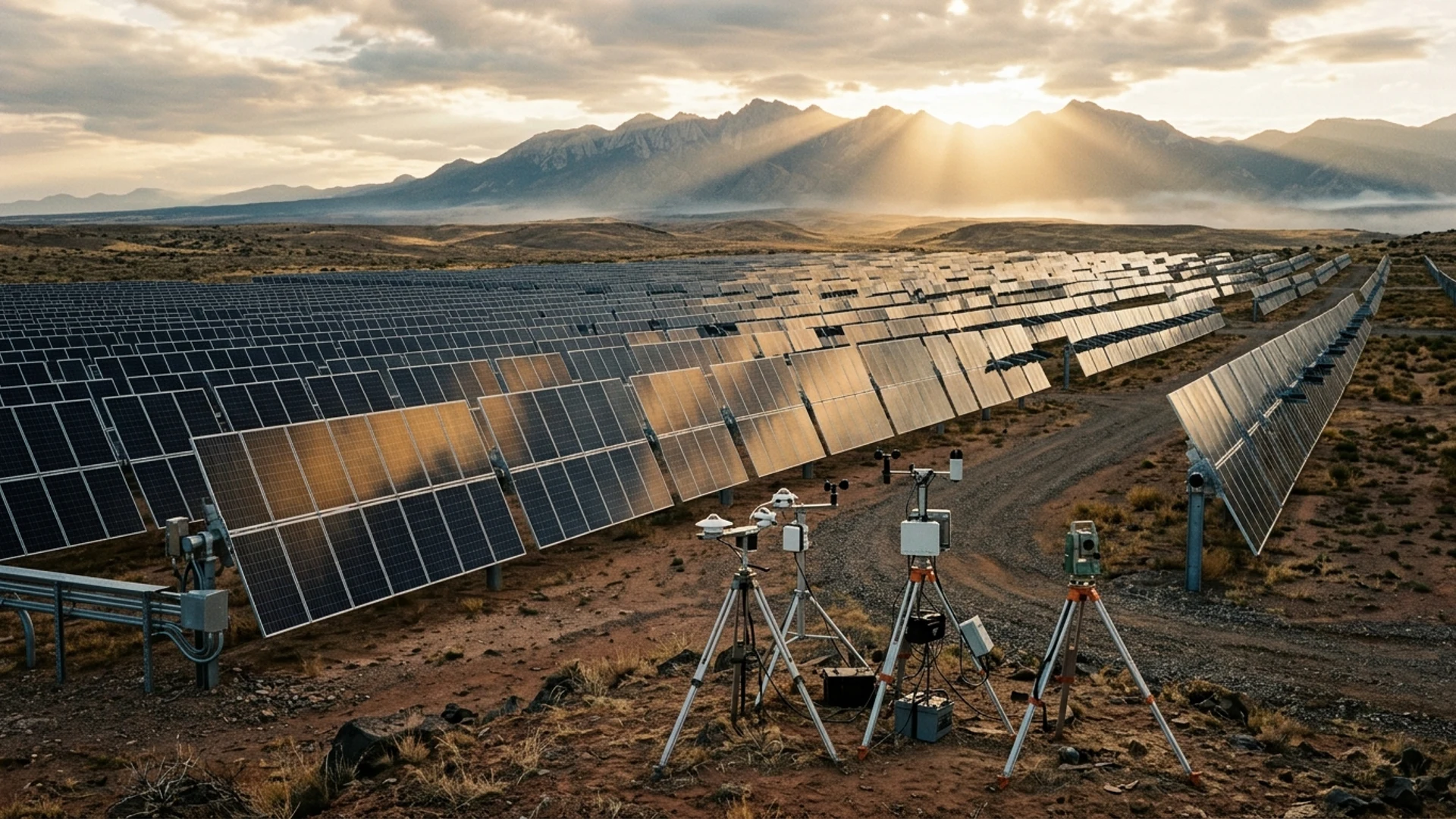
Illustrative simulation of a 50 MWp solar plant: physical field verifications (modules, pile driving, ABNT NBR 16690, and 34.5/230 kV substation) as evidentiary inputs for escrow accounts
Horizontal Segregation of Roles & Governance Barriers Flowchart
Strict segregation between physical site execution, technical sign-off, software orchestration, and banking settlement
EPC Contractor
Consolidation of commercial invoices, entry NF-e records, Siscomex customs clearance (DI/Duimp), and physical construction logs.
Independent Owner's Eng.
On-site field inspection, ABNT NBR 16690 & 16274 testing, and statutory CREA Anotação de Responsabilidade Técnica (ART).
Venko Total Group
Dossier orchestration, cryptographic SHA-256 audit hashing, two-party Maker-Checker governance, and private instructions.
Regulated Escrow Bank
Administration of the segregated escrow bank account and final tranche fund release under Central Bank supervision.
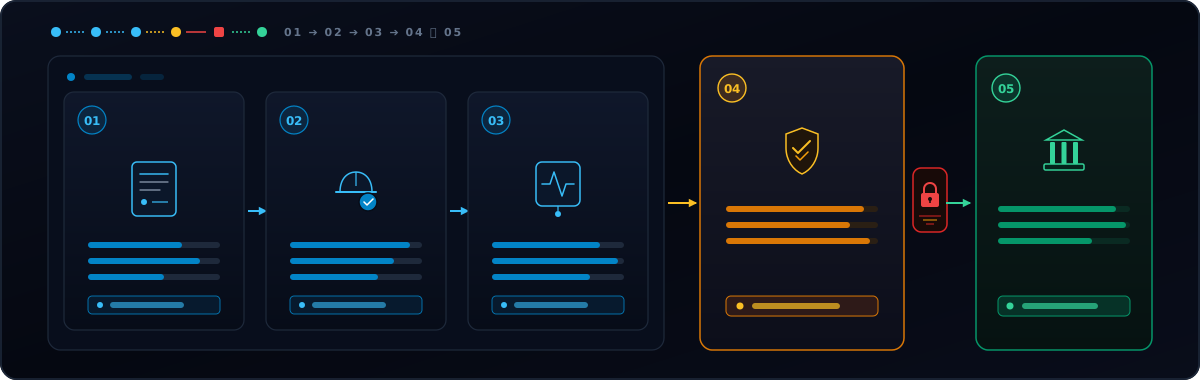
Physical engineering tranches and contractual safeguards (Didactic Example):
- T1: 25%PV Modules & Inverters SupplySupply & Customs
Siscomex customs clearance (DI/Duimp), commercial invoices, Bill of Lading (BL), entry NF-e records for 90,000 bifacial panels and 10 central inverters with georeferenced serial sampling.
- T2: 25%Civil Works, Pile Driving & TrackersCivil & Geotechnical
Topographic GNSS RTK survey, geotechnical pile pull-out tests (pursuant to project engineering specifications and certified CREA ART), and aerial drone photogrammetry.
- T3: 25%Electromechanical Assembly CC/CAElectromechanical & NBR
DC string cabling, AC feeders, combiner boxes, and electrical testing pursuant to ABNT NBR 16690:2019 and ABNT NBR 16274:2014 (insulation resistance R-iso and I-V curves) with CREA ART.
- T4: 25%Substation 34.5/230 kV & Grid InterconnectionSubstation & Grid/ONS
Energization of the step-up transformer, SCADA telemetry integration, protection relay testing, and compliance with the ONS CUST transmission agreement for connection to the SIN.
- 05Settlement Channel / Contracted CustodianContracted Institution
Formal private administrative order dispatched exclusively to the contracted regulated partner financial institution for release from a segregated escrow account. Note: step 05 is neither a fifth tranche nor a fifth disbursement, but the banking settlement channel for the 4 physical engineering tranches (where applicable, an authorized institution in the relevant jurisdiction).
If inspection reports identify non-critical Level 2 punch-list snags, the contract may stipulate a precautionary 5% to 10% retention of tranche funds in a segregated sub-account until technical remedy; no funds are disbursed automatically.
Regulatory safeguard: Illustrative didactic example. The 25% tranches and plant parameters simulate typical market models. Venko Total Group acts exclusively in technical coordination and documentary milestone governance, without custody of funds or execution of banking activities.
1. Engineering Planning & Pre-Commissioning: Preparing inspection protocols and instrument calibration logs under ABNT NBR 16274;
2. Cold Commissioning (Category 1 Tests): Continuity, polarity, and insulation resistance verification across all DC circuits and grounding systems;
3. Advanced Category 2 Testing: I-V curve tracing and aerial drone thermography verifying solar module arrays;
4. Utility Access Inspection & Substation Energization: Verifying compliance with grid connection codes (CUSD/CUST) and calibrating protection relays;
5. Hot Commissioning & Inverter Synchronization: Stepwise energization of inverter blocks and establishing real-time telemetry streaming;
6. Owner's Engineering Audit & Escrow Settlement: Issuing final Independent Engineer certification with ART, unlocking contractual milestone payment tranches.
Final Institutional Notice (Zero-Custody Principle): This document reflects technical standards in force at publication and does not replace certified professional engineering services under CONFEA/CREA regulations. Venko Total Group operates as neutral evidentiary governance infrastructure and does not provide asset custody.
Intelligence Report Conclusions & Release Governance
- •Full Regulatory Compliance: Complete alignment with Federal Procurement Law 14,133/2021, Law 13,303/2016, and federal audit standards (CGU/TCU).
- •Canonical Segregation & Zero-Custody: Strict boundary between analytical evidence coordination and regulated banking custody.
- •Immutable Cryptographic Integrity: Audited envelope with SHA-256 canonical digest and full traceability via RFC 8785.
- •Fail-Closed Shielding: Operation strictly constrained in production environments with full quorum of validated gates.